Teaching scientific computing in Santiago
Tools, techniques and software design at the 2026 CERN School of Computing in Latin America.
The school
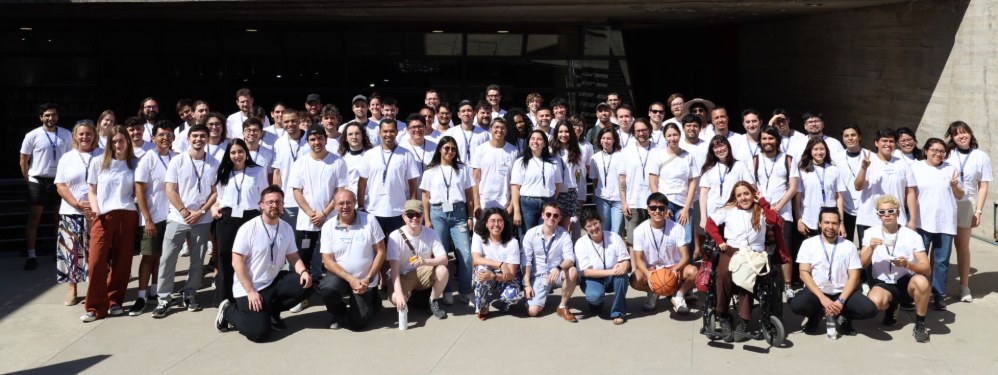
In January 2026 I taught at the 47th CERN School of Computing, held in Santiago, Chile. My sessions covered Tools and Techniques and Software Design, with lectures and practical exercises. The programme included software design for parallel and GPU architectures.
The school brought scientific questions and computing practice into the same timetable. My teaching formed part of a wider programme delivered by colleagues working across physics, data analysis and computing.
Exhibit 1DiagramRead left to right
What a session is made of
A lecture is the smallest part. The exercise, the explanation of why a result moved, and material that still works at home are what the school is for. The thread underneath is where this way of teaching comes from.
Exhibit 2TimelineFilled points are my milestones; hollow points are the context they sit in
A teaching thread
A continuing teaching thread
My teaching began at Universidad de Los Andes in Mérida, in mathematics and physics laboratories. Later I co-founded LA-CoNGA physics and helped shape its programme, sharing responsibility for research software engineering and high-energy physics projects. Its academic programme also names me in the coordination of advanced data-science topics on scientific reproducibility.
Those subjects meet in a common task: helping a learner understand the choices behind a calculation. A useful exercise leaves room to change something, observe the consequence and explain why the result moved.
Materials that can travel
The CERN programme links the teaching materials. Keeping exercises and explanations accessible lets a course continue to be useful after its final session, when participants return to their own projects and institutions.
Exhibit 3ResourcesOpen the thing itself, not a description of it